SIP vs RD: Which Is Better for Monthly Savings?
Insights on strategy, resilience, and wealth management in an evolving financial landscape.
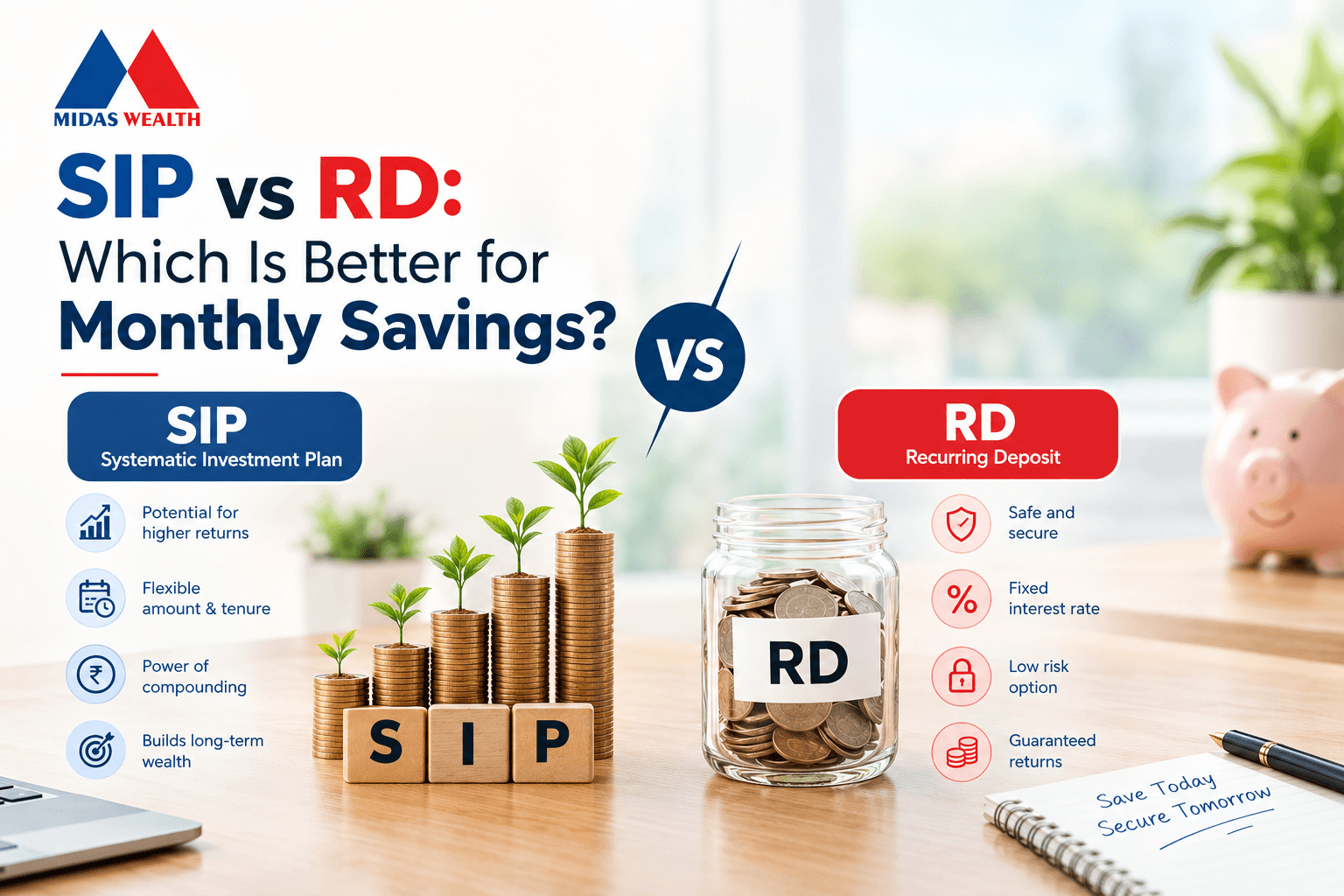
Saving money every month is an important step towards achieving financial stability and meeting future goals. Whether you want to build an emergency fund, save for your child's education, plan a holiday, or create long-term wealth, choosing the right savings option can make a difference. In India, two popular options are Systematic Investment Plans (SIPs) and Recurring Deposits (RDs).
Both options encourage regular monthly contributions, but they differ in terms of returns, risk, taxation, and flexibility. A SIP allows you to invest in mutual funds, where returns depend on market performance, while an RD allows you to deposit a fixed amount regularly and earn interest at an agreed rate.
What Is a SIP (Systematic Investment Plan)?
A Systematic Investment Plan, commonly known as a SIP, is a method of investing a fixed amount at regular intervals in a mutual fund. Most investors choose monthly contributions, although other frequencies may be available. A SIP is not a separate investment product; it is a method of investing in a mutual fund scheme.
SIP investing allows you to spread your investments across different market conditions. When prices are lower, your contribution generally purchases more units. When prices are higher, the same contribution purchases fewer units. This is commonly known as rupee-cost averaging.
What Is a Recurring Deposit (RD)?
A Recurring Deposit is a savings product offered by banks and India Post that allows you to deposit a fixed amount regularly for a specified period. The deposit earns interest according to the applicable rate and terms.
Unlike a SIP in a mutual fund, an RD is a deposit rather than a market-linked investment. Eligible bank deposits are covered by DICGC insurance up to ₹5 lakh per depositor per insured bank (principal and interest).
SIP vs RD: Example of Monthly Savings
Consider an individual who saves ₹5,000 every month for 5 years (Total invested: ₹3,00,000). The table below demonstrates how the outcomes compare illustratively:
| Feature | SIP (Mutual Fund) | RD (Recurring Deposit) |
|---|---|---|
| Monthly contribution | ₹5,000 | ₹5,000 |
| Investment period | 5 years | 5 years |
| Total contributions | ₹3,00,000 | ₹3,00,000 |
| Assumed return/rate | 10% effective annual return (illustrative) | 6.5% annual interest (quarterly comp.) |
| Estimated final value | Approx ₹3.83 lakh | Approx ₹3.55 lakh |
| Return certainty | Not guaranteed (Market-linked) | Predictable under deposit terms |
| Main risk | Market volatility risk | Inflation and institution risk |
*Illustrative estimates only. Actual mutual fund returns are market-linked and may be higher or lower. Taxes and expenses not included.
SIP vs RD: Which Is Better for Different Financial Goals?
- Short-Term Savings (1-2 years): An RD or liquid fund is generally preferable to protect capital from market fluctuations.
- Long-Term Wealth Creation (5+ years): An equity mutual fund SIP may help pursue higher inflation-beating growth.
- Emergency Funds: Keep accessible in savings accounts or high-liquidity options rather than lock-in RDs or volatile equity SIPs.
- Retirement Planning: SIPs allow long-term compounding over decades, whereas RDs offer only fixed short-to-medium-term yields.
Frequently Asked Questions (FAQs)
Is SIP Better Than RD for Monthly Savings?
It depends on your timeline. SIPs suit long-term wealth creation where market-linked growth is desired. RDs suit savers who prioritise capital predictability over shorter periods.
Is RD Safer Than SIP?
An RD offers more predictable returns and eligible bank deposits are covered by DICGC insurance up to ₹5 lakh. Mutual funds carry market risk and are not insured by DICGC.
Can I Invest in Both SIP and RD?
Yes. Many investors use RDs for short-term upcoming commitments and SIPs for long-term financial goals.
Conclusion
Both SIPs and Recurring Deposits help you develop a disciplined regular savings habit. The key is to match each option with your investment horizon, risk tolerance, and tax situation.
If you need help building an optimal savings and investment strategy, explore the financial planning and mutual fund advisory services offered by Midas Wealth Advisory through Wealth4u.in.
Important Notice: Mutual fund investments are subject to market risks. Read all scheme-related documents carefully.